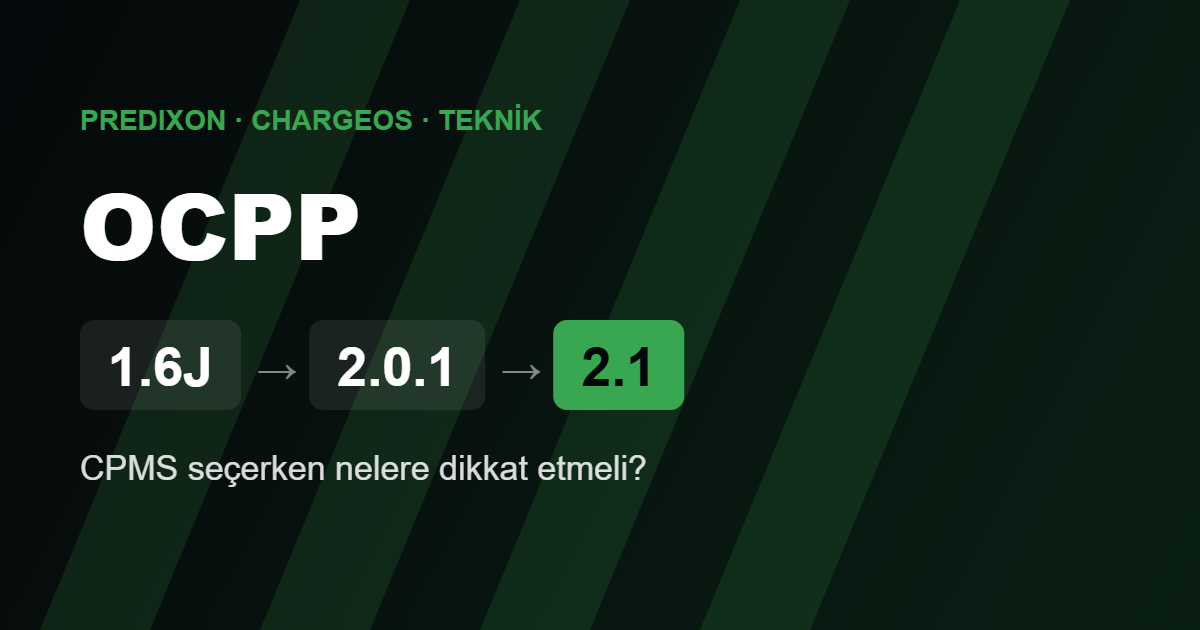

When evaluating a CPMS (Charge Point Management System), most operators start with price, interface, or the integration checklist. But underneath all of that, which OCPP (Open Charge Point Protocol) version the platform speaks — and how cleanly it supports it — shapes everything from security to smart-charging capability to your future bidirectional-charging plans. Here’s a practical comparison of OCPP 1.6J, 2.0.1, and the newer 2.1.
What is OCPP, and why does it matter?
OCPP is the open protocol, developed by the Open Charge Alliance (OCA), that standardizes communication between charging stations and the software that manages them (CPMS/CSMS). Without the right version support, a platform can’t send remote commands, push firmware updates, bill correctly, or establish a secure connection. Choosing a version isn’t a “technical detail” — it’s an operational decision.
OCPP 1.6J: the most common version in the field
1.6J (“J” for its JSON/WebSocket transport, which replaced the older SOAP-based 1.5/1.6S) is still what the vast majority of installed charging hardware worldwide speaks.
- TLS (encrypted connection) is optional — the security level is largely up to the operator.
- Covers core profiles: Core, Smart Charging (basic), Reservation, Local Auth List and Firmware Management.
- The device data model is limited; manufacturers add their own extensions, so behavior can vary between devices.
- Its strength: the most mature and widely supported version on the hardware side — most fleets in operation today still run on it.
OCPP 2.0.1: the industry standard
2.0.1 has effectively become the reference point for newly deployed stations.
- TLS + PKI-based certificate management is mandatory; Plug & Charge is supported via ISO 15118.
- Defines a full Device Model: every component and variable is individually and standardly defined, making remote configuration and monitoring far more granular.
- Offers more advanced Smart Charging profiles and campaign-based bulk firmware management.
- The installed base is still behind 1.6J, but it’s quickly becoming the standard for new projects.
OCPP 2.1: the new generation, released February 2025
OCA released OCPP 2.1 in February 2025. The protocol was built on top of 2.0.1 with minimal core changes and preserves backward compatibility with 2.0.1 — meaning the move from 2.0.1 to 2.1 is far less disruptive than the jump from 1.6 to 2.0.1 was.
Highlights:
- Native ISO 15118-20 support and V2X: a full use-case block was added for bidirectional power transfer (V2G/V2H/V2B), also compatible with CHAdeMO.
- A new Distributed Energy Resources (DER) block: dynamic load management based on solar/wind generation, static DER settings (power factor, frequency-watt curves) and DER alarms.
- Extended Smart Charging: a “LocalFrequency” mode where the station measures frequency independently and reacts via a droop curve, “LocalLoadBalancing” based on smart-meter data, and an “Idle Mode” for energy savings that can be woken remotely.
- Flexible payment options: prepaid charging (capped by amount/energy/time), ad-hoc credit/debit card payment without a contract, and one-off transactions via dynamic QR codes.
- Transaction continuity: an ongoing transaction can resume where it left off even after a forced device reboot.
The flip side: as of 2026, the amount of hardware that can fully make use of 2.1 is still limited — field maturity, especially on the V2X side, is just emerging.
Comparison table
| Criteria | OCPP 1.6J | OCPP 2.0.1 | OCPP 2.1 |
|---|---|---|---|
| Security | TLS optional | Mandatory TLS + PKI, Plug & Charge | 2.0.1’s security baseline + extended certificate flows |
| Device data model | Basic, vendor-specific extensions | Full, standardized Device Model | 2.0.1’s model + DER/V2X components |
| Smart Charging | Basic profiles | ISO 15118-compatible profiles | Local frequency/load balancing, Idle Mode, bidirectional |
| Payments | Limited | Plug & Charge | + Prepaid, ad-hoc card, dynamic QR |
| Field adoption (2026) | Largest installed base | Growing, de facto standard for new installs | Early adoption, compatible hardware still limited |
| Best fit | Existing fleets, low complexity | New installs, scaled operations | Operators planning V2X/grid participation |
4 questions to ask when choosing a CPMS
- Can the platform manage 1.6J and 2.0.1 devices in a single fleet-management layer, or does it need a separate system per version?
- Is TLS/PKI certificate management automated on the platform side, or does it depend on manual intervention from your field team?
- Does the vendor’s roadmap show concrete V2X/DER support tied to 2.1, or is it just a “future promise” today?
- Do operational layers like health-score, auto-healing and firmware management work independently of the OCPP version?
Bottom line
In practice, most operators don’t switch versions overnight; 1.6J devices in the field today, 2.0.1 at tomorrow’s new installs, and 2.1-capable hardware down the line will all coexist. So the right question isn’t “which version should I pick,” but “can the CPMS I’ve chosen manage all three generations at once, in a single operations layer.” Predixon’s ChargeOS platform supports OCPP 1.6J, 2.0.1 and 2.1 today in a single fleet-management layer — for operators who want to manage a mixed fleet without splitting it by version.
Sources: Open Charge Alliance, “OCPP 2.1 is now available!” and “What’s new in OCPP 2.1?”; Ampeco, “What Every CPO Needs to Know About OCPP 2.1”; Energic, “OCPP 1.6 vs 2.0.1 vs 2.1: Choosing the Right OCPP-Compliant Charging Software in 2026”.